
Hreflang has long been an important part of international SEO, helping search engines identify language and regional alternatives and serve the most appropriate version to users. But it wasn’t designed specifically for AI-driven search.
Whatever your favorite AI model, it aims to construct a tailored answer to your query rather than deliver a list of potential best fits that you can browse.
That answer doesn’t always come from the page you built for that market. When Glenn Gabe asked AI platforms a Spanish-language question about Cloudflare, Perplexity and Claude cited a US English page, while Copilot returned a Spanish one.
At scale, a Peec AI study of more than 10 million ChatGPT prompts found that 43% of the background searches ChatGPT ran for non-English prompts were on the English web.
Many AI assistants don’t appear to give hreflang much weight. They look for the point of your page and pull in whatever best serves their answer, in any language. Hreflang still routes users to the right version in traditional search, so it stays. But multilingual content now has two jobs: serving people who search in their own language and culture, and giving AI systems information they can clearly understand and retrieve, whatever the language.
Get clear on keywords versus topics
The rest of this article uses two words that often get used interchangeably. They are not the same thing, and the difference drives every decision below.
A keyword is a phrase a person types or says, in one language. It has a market, a volume, a seasonality, and an intent behind it.
A topic is the full question space around a need, including every sub-question sitting behind it. A topic has no language. It is what an AI system assembles an answer about, pulling from whatever sources cover it best in any language.
You research keywords per market and you build coverage per topic. Traditional search results reward the first. AI answers reward the second. International programs need both, and most of the confusion in this space comes from teams doing one and reporting on the other.
Watch how AI systems build an answer
Some AI search systems use query fan-out, breaking an initial question into related searches to gather information from multiple sources.. These searches may cross language boundaries and regions, allowing content from different markets to contribute to the final answer.
Follow the query fan-out across languages
AI systems start with the query they have, in its natural language. The query is then analyzed for its intent and a fan-out for information begins.
Unlike human-led searching, the fan-out is not necessarily bound by language. The system sends out numerous sub-queries around the original question, looking for the most relevant, authoritative sources and the most complete understanding it can gain.
All of this information is then brought back to the system and an answer is formed in the language of the user, often stripping out tone, brand, and regional particularities.
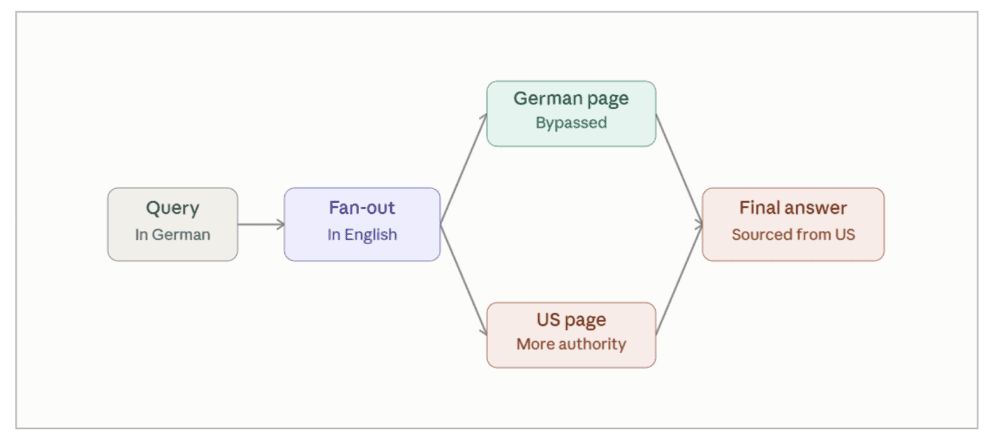
What this means is that you are no longer just competing in one language; you are competing in a topic. Your German article could be compared against content snippets from the US, Spain, Brazil or any other section of the world that may offer benefit to the combined answer.
Not only that, with the query fan-out model, you are also competing against indirect information. Content that never mentions your brand, your product or your market by name, but answers the same underlying need well enough to be pulled into the mix.
Optimize for two systems at once
Neither system can be ignored in favor of the other. Optimize purely for local intent, and you risk producing content the AI system never retrieves, however well it reads to a native speaker.
Optimize purely for the model, and you risk winning the AI citation while losing the audience it was meant to reach. The brands that hold up in both places are the ones treating this as two systems to be satisfied at once, not two jobs for two teams.
Wise, the money transfer company, operates in dozens of countries and languages, and it satisfies both systems by making the local detail the citable fact.
Its India guide to international money transfers with the State Bank of India covers what a local reader would ask about, such as the RBI’s annual remittance limit and SBI’s own per-transaction limit, and writes amounts in Indian digit grouping (₹10,00,000 rather than ₹1,000,000).
Those same facts are what an AI system needs for an India-specific query, and Wise lays them out for extraction, with a table of contents, fee and transfer-time tables, and step-by-step instructions.
Build for the topic, not the click
Traditional SEO trained us to write for the target keyword: pick a keyword, build a page around it, win the position, earn the click. Repeat this process in all of your languages and watch the traffic flow in.
Since the query fan-out process is looking for content that covers the full intent behind the search, a page built to rank for one keyword, in one language, is easy for the model to pass over.
Writing for the topic means going wider, anticipating the sub-questions, and making sure your content is holding the full answer.
Your content brief becomes: “own this topic, more completely than anything else the model can find.”
Research each market in its own language
Topic coverage only works if the research underneath it goes deep in every market. This is where a lot of “international SEO” quietly reverts to the old model: one core keyword list, built in English and then translated outward.
That approach was always a poor fit for local intent, but it’s an even worse fit for query fan-out. It hands the model near-identical phrasing across every market and gives it nothing to distinguish one region’s authority from another’s.
Real multi-market research has to work on two levels at once, because it’s feeding both systems. At the human level, it means researching each market on its own terms.
A Colombian traveler searches for “tiquetes baratos” while an Argentinian traveler searches for “pasajes baratos”. Same need, different words, with different volumes, seasons, and competing intent behind each phrase.
Skipping this step means writing linguistically correct content, but content that is intent-blind and unlikely to be selected in either scenario.
At the AI-retrieval level, the same research needs to surface the topic, not just the term. Dive deeper into the sub-questions and adjacent secondary needs a fan-out is likely to chase once it’s expanded past the original query.
Keyword research becomes the foundation of your topic cluster. Done well, this research produces content that flexes in phrasing and framing per market while staying anchored to one consistent set of facts.
Turn your research into content, URLs, and hierarchy
When your keyword research is done market by market, it has to translate into your website architecture, not just into the words on the page. This is where most international SEO setups still default to a translation-first structure, with a single content template and URL pattern churned out for each language. That approach has always been weak at matching local intent.
Content planning has to start from the topic map that the target market gave you in your research. Differentiating and personalizing for each audience is the only realistic way to win locally.
URL structure and site hierarchy must reinforce that same separation rather than paper over it. Subdirectories, ccTLDs, and site hierarchy are the technical choices, but what they signal matters more. Do you have a distinct structure built for that market? Or have you chosen to add a paper-thin shell of regional flair to boilerplate global content?
These differences may seem semantic, but they’re what show real topical authority in each market. That distinct authority makes it less likely AI systems will treat your page as one more version to consolidate.
Lock the facts that must not change by market
All of these points pull toward difference. Without an anchor, that creates chaos. If all of your regional content does not pull together and ultimately deliver the same product and positioning, you risk conflicting messaging and brand signals.
Your human readers may not notice the subtleties, but an AI system comparing your pages side by side is more likely to. If your pages contradict each other, the system may cite a clearer source instead, and your audience never sees your page.
The fix is knowing which elements can change and which can’t. Phrasing, examples, and the order of sub-questions can all vary.
These elements should change market to market; that’s what makes a page really speak to the audience reading it. Underneath that variation, the facts have to hold true: the brand name, the core offering, product specs.
For example, if your French page lists a 30-day return window and your German page still says 14 days after a policy change, an AI system answering in either language may cite the wrong figure, or decide neither page is reliable enough to cite.
Deliver consistency where it matters and personalization where it is needed, and a model no longer sees scattered regional pages as half-matching accounts of the same brand. It sees one entity speaking consistently and serving the user in the most authoritative way possible.
Check how AI systems treat your regional pages
Before reworking your content, find out whether the problem affects you.
- Test prompts per market. Take your 10 to 20 most important questions, phrase them the way local users would, and run them in ChatGPT, Perplexity, Gemini, and Copilot from each market (through a VPN or local colleagues). Record which page gets cited and in which language.
- Check your log files. See which language versions AI crawlers such as GPTBot, OAI-SearchBot, PerplexityBot, and ClaudeBot actually request. A regional section they rarely visit is unlikely to be cited.
- Compare the facts. Put your regional pages for the same product side by side and check that names, specs, and prices match where they should.
If AI answers in Spanish keep citing your US page, that’s the gap this article is about.
Two systems, one brand
Put together, this is the shift international SEO is going through. Hreflang, local URLs and regional content are still important. They’re what make you findable. But being findable in one market is no longer the whole job. You’re also being read, compared, and rewritten by a system that stitches your regional presence together with everyone else’s, in a language and a format you don’t get to choose.
Local relevance and brand consistency reinforce each other instead of competing. Get that balance right, and the same content works twice: it earns the trust of the system and the eye of the reader.